If you’ve recently received a service quote in Mississauga and felt that gut-punch moment—that pause where you’re not sure if you’re being taken advantage of or if the price is legitimate—this guide is for you. The automotive service market in Mississauga has shifted considerably over the past two years.
Parts inflation post-COVID never fully reversed. Labour rates at dealerships have crept up to $175–$220/hour in some Peel Region locations. And the emergence of more independent specialists has created a genuinely competitive—but confusing—pricing environment for the average car owner.
Here’s the reality: most online “price guides” are either too vague to be useful (“oil changes cost $40–$120!”) or so dealership-focused that they’re irrelevant to anyone who doesn’t drive a brand-new vehicle under warranty. Neither serves you well when you’re standing at a service counter in Cooksville or Erin Mills trying to decide whether to approve a $900 repair.
This guide is built differently. It’s grounded in the actual Mississauga market — the labour rates shops are charging in 2026, the parts markup realities at independents versus dealers, the hidden costs that inflate your final bill, and the specific services where you’re almost always being overcharged. Understanding the true car service cost in Mississauga 2026 means knowing not just the sticker price but the mechanics behind it: why a timing chain service at a Honda dealer costs $600 more than at a reputable independent, what “shop supplies” actually covers, and when OEM parts are genuinely necessary versus a upsell.

The Mississauga market has specific characteristics that matter. This is a high-density, high-competition zone. You have Dixie Road corridor shops competing with Square One area dealers, and the 401/410 interchange independents fighting for the same customers. That competition is good for pricing — in theory. But it also creates a race-to-the-bottom on transparency, where some shops win business with a low door rate and recover margin through parts markup, advisory upsells, or inflated “diagnostic fees” that never apply toward the actual repair cost.
Whether you drive a 2018 Civic, a 2021 F-150, or a 2015 German luxury car, the framework for evaluating car service cost Mississauga 2026 is the same: understand the labour rate, understand the parts sourcing, understand the diagnostic model, and know which services warrant premium pricing and which don’t. This guide covers all of it — with actual 2026 price ranges, comparison tables, and the insider context you need to make smart decisions.
Car Service Cost in Mississauga 2026: The Complete No-BS Price Guide
The Real Cost Structure of an Auto Service Shop in Mississauga
Most customers think a service invoice is simple: parts + labour = total. It’s not. Understanding what’s actually inside your bill is the single most important thing you can do before approving any repair.
Labour Rate: What Auto Service Shop in Mississauga Are Actually Charging in 2026
Labour rate is the per-hour charge for a technician’s time. In Mississauga specifically, here’s what the market looks like heading into 2026:
- Franchise dealerships (Toyota, Honda, GM, Ford, etc.): $175–$225/hour
- Independent European specialists (BMW, Mercedes, Audi, VW): $140–$185/hour
- General independent shops (non-brand-specific): $110–$155/hour
- Quick-lube/tire chains (Midas, Speedy, etc.): $100–$130/hour
Those ranges aren’t random. Dealerships justify their premium through factory-trained technicians, proprietary scan tools, and warranty liability. But here’s what they don’t tell you: the technician working on your 2019 Corolla at a Toyota dealer may have exactly two years of experience. The independent specialist down the road may have 20 years on that specific platform. The credential gap between “dealer technician” and “experienced independent” is often fictional — and the $60–$70/hour premium you pay at the dealer doesn’t reflect skill, it reflects overhead.
Labour isn’t just charged by the clock, either. Most shops use flat-rate billing — which means they charge you a fixed number of hours for a given job based on published times (Mitchell, AllData, Autodata), regardless of how long the job actually takes. An oil change that takes 20 minutes is billed as 0.3–0.5 hours. A front brake job listed at 1.8 hours will be billed as 1.8 hours whether it takes 55 minutes or 2.5 hours. Flat-rate protects the shop’s revenue consistency. Whether it protects you depends entirely on the job and the shop’s honesty.
Parts Markup: The Invisible Margin
Parts markup is where many shops in Mississauga make a significant chunk of their actual profit — and it’s almost never disclosed upfront.
Here’s how it typically breaks down:
- OEM parts from dealer: Shop pays roughly 20–30% below MSRP, passes cost to you at full retail or above
- OEM equivalent (aftermarket quality-tier like Denso, Bosch, NGK): Shop pays cost, marks up 40–80% to customer
- Budget aftermarket: Shop pays very low cost, marks up 100–150%+
A set of front brake pads for a 2020 Honda CR-V has an OEM part cost of approximately $85–$100 through Honda Canada. A Bendix or Wagner equivalent runs the shop $28–$40. The customer price for either at many independent shops lands between $85–$110. The margin difference is massive — and the performance difference is often minimal if you’re buying quality-tier aftermarket.
This matters because when a shop quotes you “parts + labour,” you’re not comparing apples to apples between shops unless you know the exact parts being used. Always ask for the part brand and part number. A shop that resists this question is one you should approach with caution.

Shop Supplies, Environmental Fees, and “Administration” Charges
This is the line item that quietly inflates bills across Mississauga. “Shop supplies” is a catch-all for rags, cleaning solvents, hardware clips, zip ties, and consumables. It’s legitimate — these things have real cost. But the amount charged is often disconnected from actual consumption.
Standard practice: 2–5% of labour charges. What some shops charge: a flat $25–$45 per visit regardless of job complexity.
Environmental handling fees for fluids, tires, and batteries are also standard and provincially regulated — but the amounts are sometimes inflated beyond the actual disposal cost. Expect $5–$15 for an oil change environmental fee; $10–$20 for battery disposal; $5/tire for tire disposal (capped at $20/visit at most legitimate shops).
Routine Maintenance Costs in Mississauga: What You Should Know About
Routine maintenance is where the widest price variance exists. It’s also where the most unnecessary upsells happen. Let’s go line by line.
Oil Change Cost Mississauga 2026
Oil change pricing in Mississauga has a wide spread driven almost entirely by oil specification and volume:
| Vehicle Type | Oil Spec | Dealer Price (2026) | Independent Price | Quick Lube Price |
|---|---|---|---|---|
| Economy/Compact (4-cyl, ~4.5L) | 0W-20 Full Synthetic | $110–$140 | $75–$100 | $65–$90 |
| Mid-size Sedan/SUV (~5.5L) | 5W-30 Full Synthetic | $120–$155 | $85–$115 | $75–$100 |
| Truck/Large SUV (~8L) | 5W-30 Full Synthetic | $155–$200 | $110–$145 | $95–$130 |
| European (BMW, Audi, MB) | 0W-40 or LL-01 | $175–$250 | $130–$185 | Rarely done |
| Diesel (Duramax, Power Stroke) | 15W-40 or 5W-40 Diesel | $200–$280 | $150–$220 | $130–$180 |
The biggest variable is oil volume and specification. A BMW 5-Series takes 6.5L of BMW-approved LL-01 rated oil; deviating from that spec isn’t a frugality move, it’s a maintenance error. A Honda Civic takes 3.7L of 0W-20. The cost difference between those two oil changes is entirely rational and legitimate.
Air Filter Replacement
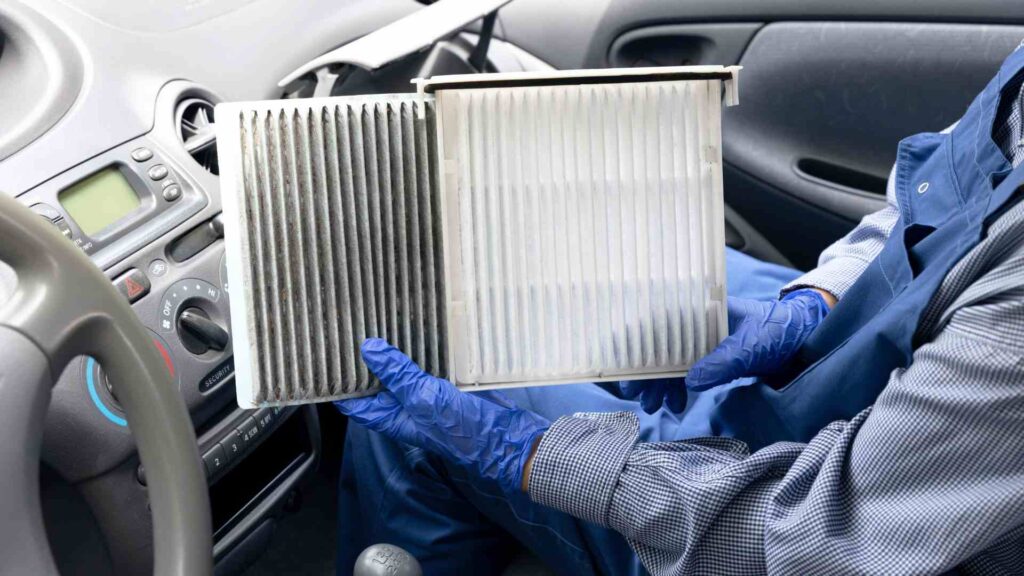
Cabin air filter: $35–$85 for parts, $20–$40 labour. Engine air filter: $25–$65 parts, $20–$35 labour.
The actual labour involved in most air filter replacements is 5–15 minutes. Yet shops routinely charge 0.3–0.5 flat-rate hours. On a $140/hr shop, that’s $42–$70 in labour for something a competent DIYer can do in 8 minutes. This is one service where inspecting the filter yourself — most are accessible without tools — and comparing the shop’s quoted price to the urgency of the replacement is absolutely worthwhile.
Tire Rotation and Wheel Balance
Tire rotation alone: $25–$50 at most Mississauga shops when done standalone. When bundled with an oil change: often $15–$30 incremental.
Wheel balance: $15–$20 per wheel, $60–$80 for a full set of four. Road-force balance (which identifies tire uniformity issues, not just wheel imbalance): $25–$35/wheel, $100–$140 for four.
If you’re experiencing a vibration between 90–120 km/h that standard balancing hasn’t resolved, road-force balance is the right diagnostic step — not new tires. Many Mississauga shops don’t offer road-force because the machine costs $20,000–$30,000 to purchase. Those that have it are worth the premium for vibration diagnosis.

Brake Service Costs Mississauga 2026: What’s Legitimate, What’s Not
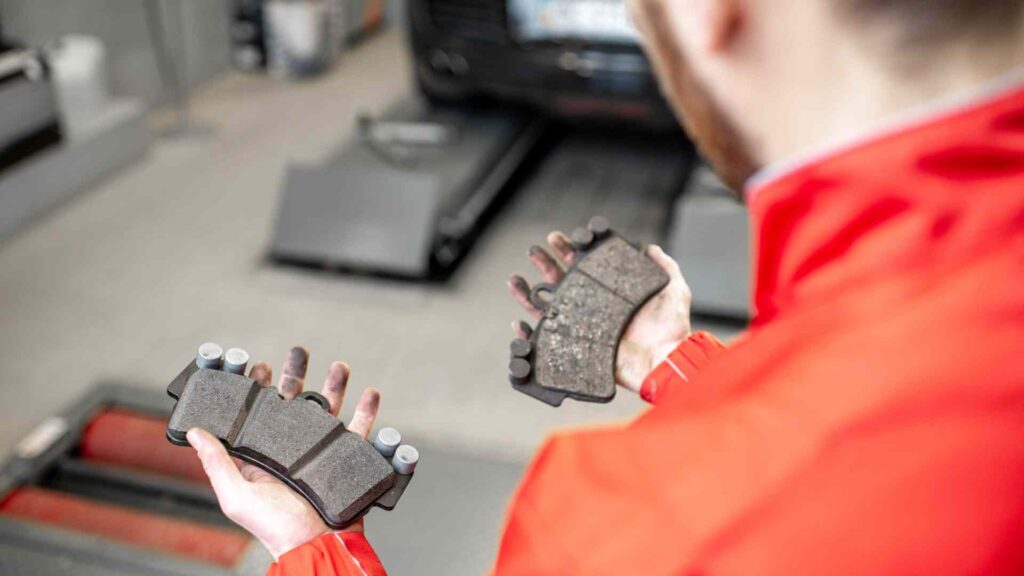
Brakes are the highest-volume upsell category in the automotive service industry. Not because shops are necessarily dishonest — but because brake wear is visible on inspection reports, easy to present as urgent, and generates meaningful revenue.
What a Complete Front Brake Service Actually Involves
A proper front brake job on a typical passenger car includes:
- Remove wheel and caliper assembly
- Inspect caliper slides, pistons, and hardware
- Replace pads (always) and rotors (based on thickness/condition measurement)
- Clean and lubricate caliper slide pins and abutment clips
- Retract caliper piston(s)
- Reinstall with torque-spec tightened fasteners
- Bed-in pads with controlled stops
Cutting corners on steps 4 and 6 is extremely common. Un-lubricated slide pins cause uneven pad wear and premature failure within 12,000–18,000 km. Under-torqued wheel fasteners are a safety issue. These aren’t optional steps — they’re the job.
Brake Pricing Comparison Table: Mississauga 2026
| Service | Dealer Price | Independent Price | Notes |
|---|---|---|---|
| Front pads only (no rotor) | $280–$380 | $180–$260 | Only viable if rotors measure within spec |
| Front pads + rotors | $480–$700 | $320–$480 | Most common front brake service |
| Rear pads only | $240–$340 | $160–$240 | Rear often electric park brake = more labour |
| Rear pads + rotors | $420–$620 | $280–$420 | |
| Full 4-wheel brake service | $900–$1,400 | $580–$900 | Rotors at all 4 corners |
| Caliper replacement (one) | $280–$450 inc. labour | $180–$320 inc. labour | Includes bleeding |
| Brake fluid flush | $100–$160 | $70–$110 | Should be done every 2 years, not every oil change |
Expert Insight: Rotor replacement decisions should be made with a micrometer, not a visual inspection. Every rotor has a minimum thickness spec stamped on the hat (or listed in service data). If the rotor measures above minimum specification and shows no heat cracking, it doesn’t need replacement — period. Any shop that replaces rotors without measuring them first is either incompetent or upselling. Ask to see the measurement. If they can’t produce it, that’s information.
The Brake Fluid Flush Upsell
Brake fluid hygroscopy — its absorption of moisture from the atmosphere — is real. DOT 3 and DOT 4 fluids absorb moisture over time, which lowers the boiling point and can cause fade under hard braking. A brake fluid flush every two years or 40,000 km is legitimate preventive maintenance.
What’s not legitimate: recommending a brake fluid flush at every oil change, which some shops do. The test strips shops use to “demonstrate” fluid degradation are notoriously inaccurate. A refractometer or electronic moisture tester is the correct tool. If a shop is recommending fluid flushes more than once every two years on a normal-use vehicle, push back.
Engine and Drivetrain Service Costs: The High-Stakes Category
This is where repair bills in Mississauga can rapidly escalate to $1,000–$5,000+. The difference between a competent shop and an average one is most visible here.
Timing Belt vs. Timing Chain: Understanding the Real Cost
Timing belt service is among the most consequential scheduled maintenance items on interference-engine vehicles. Missing the interval isn’t a minor oversight — it’s a potential engine replacement scenario.
Timing belt service (includes belt, tensioner, idler pulleys, water pump where applicable):
- 4-cylinder compact: $600–$950 at independents, $800–$1,300 at dealers
- V6 (Odyssey, Pilot, Ridgeline 3.5L): $900–$1,400 at independents, $1,200–$1,800 at dealers
- Subaru EJ-series (2.5L with head gasket considerations): $900–$1,200 for belt service alone
The water pump question is critical. On most interference engines, the water pump is driven by or shares the timing belt circuit. Labour overlap means doing the water pump simultaneously costs an extra $80–$150 in parts with essentially zero additional labour. Skipping the water pump and having it fail at 80,000 km means doing the entire timing belt service again. The math is obvious.
Timing chain engines (most modern engines after 2015) don’t have scheduled chain replacement — but they’re not maintenance-free. Chain stretch, tensioner wear, and variable valve timing (VVT) actuator issues are real failure modes. The tell: a cold-start rattle in the first 3–5 seconds that disappears once oil pressure builds. That’s an extended-crank chain rattle. It gets progressively worse and the repair window closes quickly.
Transmission Service Costs Mississauga 2026
| Transmission Service | Price Range (Independent) | Price Range (Dealer) |
|---|---|---|
| Automatic fluid drain & fill (most vehicles) | $120–$200 | $160–$280 |
| Automatic full flush (via exchange machine) | $180–$280 | $250–$380 |
| CVT fluid service | $160–$240 | $220–$350 |
| Manual transmission fluid change | $80–$140 | $110–$190 |
| Transfer case fluid | $80–$130 | $100–$170 |
| Front/rear differential fluid | $80–$130 per diff | $110–$180 per diff |
Diagnostic Costs and Scan Tool Reality in Mississauga
Diagnostic work is the most misunderstood cost category in automotive service. It’s also where independent shops can most effectively differentiate themselves from chains.
What a Proper Diagnostic Actually Involves
A check engine light is not a diagnosis. A scan tool code (P0420, P0300, etc.) is not a diagnosis. These are starting points for diagnosis, not conclusions. The distinction matters enormously for your wallet.
A P0420 code (catalyst efficiency below threshold) on a 2017 Civic could mean:
- A failing catalytic converter ($600–$1,200 to fix)
- An oxygen sensor reading incorrectly ($180–$280 to fix)
- An exhaust leak upstream of the catalyst ($80–$200 to fix)
- Engine misfire history causing cat contamination (address the misfire first)
A shop that reads P0420 and immediately quotes a catalytic converter hasn’t diagnosed anything. They’ve made an assumption. A shop that pulls live O2 sensor data, checks for exhaust leaks, reviews misfire freeze frame data, and clears the code to monitor under driving conditions — that’s diagnosis.
Diagnostic fees in Mississauga 2026:
- OBD-II code read only (chain shops): Often “free” — which reflects the depth of the service
- Hourly diagnostic rate: $110–$180/hour depending on shop tier
- Dealer diagnostic minimum: $140–$200 (approximately 1 hour minimum, non-refundable at many dealers)
- Complex electrical/intermittent fault diagnosis: 2–5+ hours realistic for genuinely difficult faults
The “free diagnostic” marketing from chain shops is worth understanding critically. Reading a code costs nothing because the reader costs $30 at Canadian Tire. Interpreting what the code means, in the context of the vehicle’s full history, sensor data patterns, and known TSBs — that’s the diagnostic. That costs real time and expertise.
Software and Module Programming Costs
This is an increasingly significant cost category as vehicles become more software-dependent. Replacing a module (ECU, BCM, TCM) without programming renders it non-functional. Programming requires either dealer-proprietary tools or professional aftermarket platforms (Autel, Launch, J2534 pass-through).
- ECU/PCM programming: $150–$350 at independents with the correct equipment; $200–$450 at dealers
- Key fob programming (after battery replace or new key): $50–$150
- Immobilizer/PATS relearn: $100–$250
- Idle relearn/throttle body adaptation post-cleaning: $50–$80 (or DIY on many platforms)
Not all independents in Mississauga have J2534 programming capability or current subscriptions to OEM calibration databases. This is a legitimate reason to use a dealer for certain module-related work — not because dealers are better technicians, but because they have proprietary access to current calibration files.
Seasonal Service Costs and Mississauga-Specific Considerations
Mississauga sits in a climate zone that imposes specific maintenance demands. The freeze-thaw cycles, road salt use from November through April, and summer heat combine to accelerate certain failure modes that southern Canadian climates don’t face.
Winter Tire Installation and Storage Costs
Tire changeover (mount and balance, assuming you have a second set on rims): $60–$100 in fall, $70–$120 in spring when demand peaks. Many shops in Mississauga charge a premium in October–November when appointments are booked solid.
Tire storage: $150–$250/season at most Mississauga shops. Worth calculating whether it’s cheaper to store tires yourself (garage space) versus paying for shop storage — at $200/year, a 4-car household is spending $800 annually purely on tire storage.
Seasonal fluid considerations specific to Mississauga:
- Washer fluid: Use -40°C rated fluid from October through April. Standard summer fluid freezes in the reservoir, cracking the pump housing — a $80–$120 repair.
- Coolant testing: Coolant should protect to at least -40°C. Many vehicles going into their 5th+ year have degraded coolant that now protects only to -25°C or -30°C. A refractometer test takes 30 seconds.
- Battery testing: Cold-cranking amps matter in Mississauga winters. A battery that starts fine at 15°C may fail at -15°C. Load-test annually before November. Battery replacement in Mississauga: $180–$320 including installation and disposal fee.
Rust and Undercarriage Reality
Road salt exposure from November to April in Mississauga creates accelerated corrosion on brake hardware, fuel lines, exhaust components, and suspension fasteners. This has real service cost implications:
- A brake job on a 10-year-old vehicle in Mississauga routinely requires heat and penetrating oil to extract seized caliper bolts and brake hardware — adding 30–60 minutes of legitimate labour versus the same job in a non-salt region
- Exhaust work (flex pipe, catalytic converter, muffler) on vehicles 8+ years old often requires cutting seized fasteners, adding $50–$150 to any quoted exhaust job
- Suspension component replacement (ball joints, control arm bushings, sway bar links) frequently involves cutting off seized hardware — factor an additional 30–60 min labour per corner
This is not shops padding bills. Seized fasteners are a real and predictable consequence of Mississauga winters. Any quote for brake, exhaust, or suspension work on a vehicle 7+ years old should include a clause about potential additional labour for seized hardware — and the amount should be discussed before work begins, not disclosed on pickup.
How to Evaluate a Car Service Quote in Mississauga: A Practical Framework
Understanding the car service cost Mississauga 2026 environment means being able to evaluate a quote intelligently, not just shop by price.
The Five-Question Framework
1. What is your labour rate? Get this upfront. If the rate isn’t disclosed, ask directly. Any legitimate shop will answer without hesitation.
2. What parts brand/grade are being used? OEM, OEM-equivalent (Denso, Bosch, NGK, Brembo), or budget aftermarket? Each tier is appropriate in different contexts. On sensors, timing components, and safety items, OEM or OEM-equivalent is generally worth the premium. On maintenance consumables and hardware, quality aftermarket is often identical.
3. Is the diagnostic fee applied toward the repair? If you pay $120 for diagnostics and proceed with a $400 repair, is it $400 or $520? Many shops apply the diagnostic fee toward the repair. Some don’t. Know which you’re dealing with before authorizing the diagnostic.
4. Will you get a written estimate before any work begins? This is your legal right in Ontario under the Consumer Protection Act. A shop that is reluctant to provide a written estimate before beginning work is one you should be cautious about.
5. What’s the warranty on parts and labour? Reputable Mississauga shops offer 1 year/20,000 km minimum on parts and labour. Dealers often offer 12 months/20,000 km on standard repairs. Shops offering no warranty or 90 days only are worth scrutinizing.
Red Flags in a Service Quote
Specific patterns to watch for:
- Every-visit upsells on the same items: If fuel injection cleaning, transmission flush, and coolant flush are recommended at every single oil change, that’s a revenue pattern, not a maintenance pattern.
- Refusing to show old parts: Any competent shop will show you replaced parts on request. If a shop replaced your brake pads, the old pads should be available to inspect. Refusal is a significant integrity concern.
- Vague labour descriptions: “Miscellaneous repairs – 3.0 hrs” is not a legitimate line item. Every hour of labour should have a corresponding task description.
- Pressure tactics on safety items: Stating “we can’t let you drive this out of our shop” without documented, measured evidence of the safety concern is coercive and, in most cases, legally questionable.
The Independent vs. Dealer Decision Matrix
The car service cost Mississauga 2026 picture isn’t simply “dealers cost more” — it’s about matching the job to the right resource.
Use a dealer for:
- Warranty work (required by manufacturer)
- Software programming and module calibration
- Technical service bulletins requiring OEM tooling
- Vehicles under 3 years old where maintaining dealer history matters for resale/warranty
Use a reputable independent for:
- Any out-of-warranty maintenance (oil changes, brakes, tires, filters)
- Engine mechanical work where brand-specific experience exists
- Diagnostic work on high-mileage vehicles where a flat diagnostic minimum is wasteful
- Anything where you’ve built a trust relationship with the shop and its technicians
The hybrid approach: Diagnostic at dealer (for TSB access and proprietary scan data) → repair execution at trusted independent. This works particularly well for complex electrical faults on modern vehicles where OEM scan data is essential for diagnosis but the physical repair doesn’t require dealer execution.
Getting Actual Value From Your Car Service Budget in Mississauga
The single biggest waste of car maintenance money isn’t paying too much for a specific service. It’s the cumulative cost of deferred maintenance that compounds into major repairs.
A transmission fluid service at 80,000 km costs $160–$200. A transmission replacement because fluid degradation wasn’t addressed costs $3,500–$7,000. The math on preventive maintenance is not complicated, but it requires a shop you trust enough to follow their recommendations — and that trust is only possible if you understand what’s being recommended and why.
Building a relationship with a specific technician or shop in Mississauga — rather than price-shopping every single service — pays dividends in three ways. First, they know your vehicle’s history and can identify patterns (e.g., an oil consumption trend that warrants investigation before it becomes engine damage). Second, established customers typically get priority scheduling, honest assessments, and more flexible warranty treatment. Third, the shop has a strong incentive to retain your long-term business rather than maximize the single visit.
The car service cost Mississauga 2026 reality is that the best-value shop isn’t always the cheapest quote — it’s the one with transparent pricing, documented recommendations, and a track record of accurate diagnosis and durable repairs. That combination of transparency, technical competence, and fair market pricing is exactly what separates a shop worth your trust from one worth avoiding.
Your 2026 Action Plan for Car Service in Mississauga
Stop guessing at car service costs. Start with a clear understanding of what your vehicle actually needs — based on mileage, age, and driving conditions specific to Mississauga — and match that to a shop that operates transparently.
Here’s the practical sequence:
Pull your owner’s manual and identify every scheduled service due within the next 30,000 km. Cross-reference that list against the pricing ranges in this guide. For anything over $300, get two quotes — one from a dealer, one from a reputable independent — and compare not just the total but the parts tier, the warranty terms, and the diagnostic rationale.
For vehicles under 5 years old with fewer than 80,000 km: focus on maintenance adherence and building a relationship with a quality independent shop now, before warranty expiry forces dealer dependence. For vehicles 6–12 years old and 100,000–180,000 km: this is the highest-value window for independent specialists who know older platforms — the savings versus dealer pricing can be substantial. For vehicles 12+ years or 200,000+ km: the calculus shifts toward repair-versus-replace decisions on major items; a trusted shop’s honest assessment of vehicle condition is worth more than any single price comparison.
The Mississauga automotive service market rewards informed customers. Know your rates, know your parts, know your rights under Ontario consumer protection law, and choose shops that welcome those questions rather than deflect them.
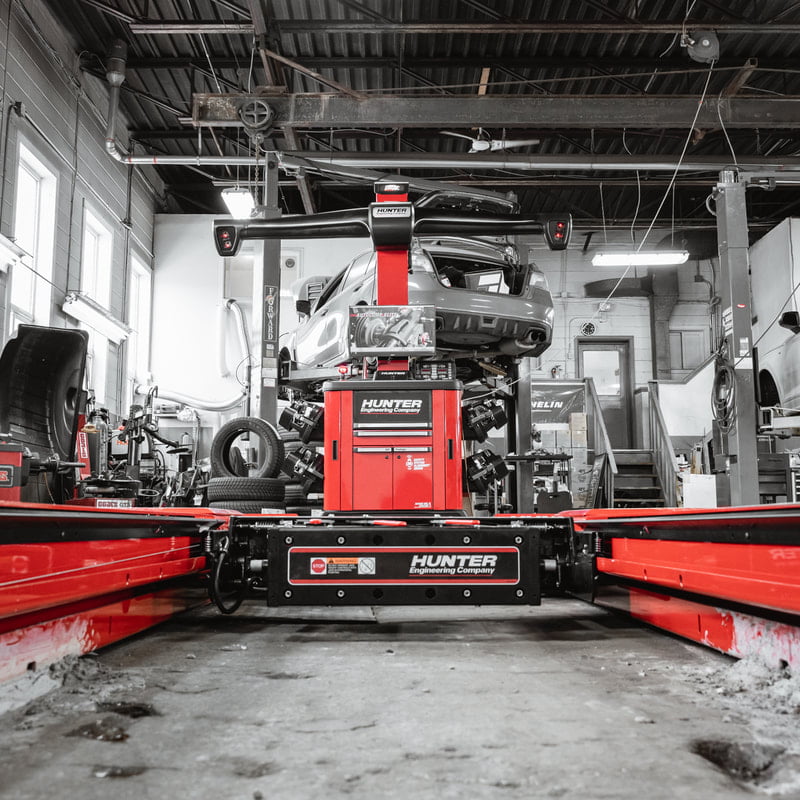
YST Tuning operates with transparent pricing, documented estimates, and the technical depth to handle everything from routine maintenance to complex performance and diagnostic work. Ready to get a real quote with no guesswork? Visit ysttuning.com or call to speak directly with a technician who knows Mississauga roads, Mississauga winters, and what your specific vehicle actually needs.