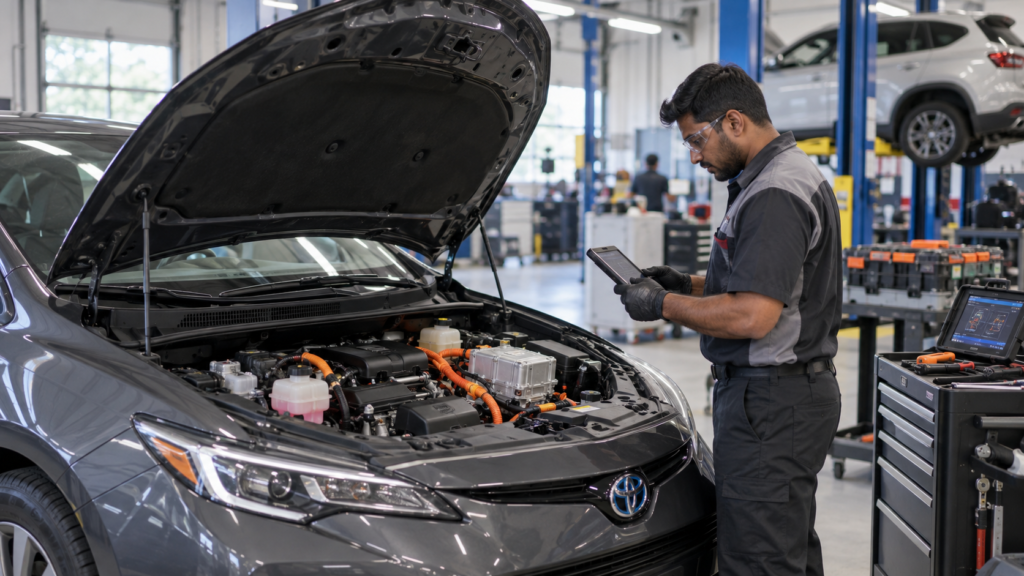
Hybrids are everywhere in Mississauga now, from Corolla and RAV4 Hybrids doing the school run to Camry Hybrids racking up kilometres on rideshare apps around Square One and Pearson. If you’ve recently bought one, or you’re wondering whether the dealership is really the only place that can touch it, the good news is that hybrid maintenance is simpler than most drivers expect. It’s not a different car underneath; it’s a gas engine with an electric assist bolted on, and most of your regular vehicle maintenance schedule stays exactly the same.
That said, a handful of things genuinely are different, and getting them wrong, or paying dealership prices for work an independent shop handles just as well, adds up over the years you own the car. This guide covers what changes with a hybrid, what stays the same, and what a Mississauga mechanic should be checking that a typical gas-only inspection would miss, including areas like batteries and electrical systems and brake service where hybrids genuinely work differently under the hood.
Hybrid Car Maintenance in Mississauga: What’s Different From a Gas Vehicle
What’s Actually Different About a Hybrid Car
A hybrid car combines a gasoline engine with one or more electric motors and a high-voltage battery pack, and a control computer decides moment to moment which one is doing the work. That changes a few specific systems in the car without changing most of the rest.
- The braking system captures energy through regenerative braking, which changes how the brake pads and rotors wear over time
- There’s a separate 12-volt battery for accessories and starting the system, on top of the large high-voltage hybrid battery
- The engine cycles on and off automatically at stops and low speeds, which changes belt, engine mount, and starter wear patterns
- Some models use a continuously variable transmission (CVT) or an electronic transmission unique to hybrid drivetrains, with its own fluid requirements
- The air conditioning compressor is often electric rather than belt-driven, so it can run even when the gas engine is off
None of this makes a hybrid car fragile or unusually expensive to maintain. It just means a shop working on your car needs to know where these differences are, rather than treating it exactly like a conventional gas vehicle from bumper to bumper.
Do Hybrids Still Need Regular Oil Changes?
Yes, and this is the most common misconception we hear from new hybrid owners in Mississauga. The gasoline engine in a hybrid car still needs regular oil changes on the same rough interval as a comparable gas-only engine, typically every 8,000 to 12,000 kilometres depending on the manufacturer and oil type.
The twist is that because the engine shuts off frequently at idle and during electric-only driving, oil can sit unused for longer stretches between actual running time, and short trips around town don’t always let the engine reach full operating temperature. Both of those conditions favour sticking closely to the manufacturer’s recommended interval rather than stretching it, since oil that doesn’t fully warm up doesn’t burn off condensation and short-trip contaminants as effectively.
Hybrid Battery Health: The 12-Volt Battery and the Hybrid Battery Are Different
Every hybrid car actually has two batteries, and mixing them up is where a lot of confusion starts.
The 12-Volt Battery
This is a smaller, standard-looking battery that powers the car’s accessories, computers, and the system that starts up the hybrid drivetrain, similar in concept to the battery in a gas-only car. It’s the one most likely to leave you stranded in a Mississauga parking lot on a cold January morning, and it typically needs replacing every four to six years, same as a conventional car battery. If your hybrid car won’t power on at all, dash lights included, this 12-volt battery is usually the first thing to check, not the large hybrid battery pack.
The High-Voltage Hybrid Battery
This larger battery pack powers the electric motor. Modern hybrid battery packs are built to last a long time, commonly eight to fifteen years or well over 150,000 to 200,000 kilometres, and Ontario’s climate is not particularly hard on them compared to extreme heat regions.
Warning signs of a genuinely failing hybrid battery include a noticeable drop in fuel economy, the gas engine running more often than it used to even in stop-and-go traffic, or a warning light specific to the hybrid system on the dashboard. Full hybrid battery pack replacement is a real cost, but it’s also less common than owners fear, and Mississauga mechanic shops equipped for hybrid diagnostics can usually tell the difference between a battery that’s genuinely failing and a software or sensor issue that just looks like one.
Why Hybrid Brakes Wear Differently
Regenerative braking is one of the most misunderstood parts of hybrid car ownership. When you take your foot off the accelerator or apply light braking, the electric motor acts as a generator, slowing the car down and sending energy back to the battery instead of relying purely on the friction brakes. The traditional brake pads and rotors only take over fully for harder stops.
The upshot is that hybrid brake pads often last noticeably longer than on a comparable gas vehicle, sometimes well beyond typical replacement intervals, since the friction brakes simply do less of the work in daily driving. The catch is that pads and rotors that sit unused for long stretches can develop light surface rust or corrosion, especially through a Mississauga winter with road salt in the mix, and that can cause a grinding or scraping sound even when the pads still have plenty of material left. This is a case where a technician familiar with hybrids matters: chasing a brake noise on a hybrid without accounting for regenerative braking behaviour can lead to pads being replaced too early, or a surface rust issue being missed because “the pads still look fine.”
Transmission, Cooling System, and Other Fluids
Most hybrids use either a conventional automatic transmission, a CVT, or an electronic continuously variable transaxle specific to the hybrid system, and each has its own fluid type and change interval that isn’t always the same as the standard automatic transmission fluid used in a comparable gas model. Using the wrong fluid or skipping fluid checks because “it’s a hybrid, it probably doesn’t need it” is one of the more expensive mistakes we see.
Hybrids also typically run a separate cooling circuit for the power electronics and inverter, in addition to the normal engine cooling system. This coolant has its own service interval and isn’t something a generic coolant flush necessarily covers unless the shop specifically checks for it. It’s a small thing, but it’s exactly the kind of detail that gets missed at a general shop that doesn’t regularly see hybrids come through the bay.
Air Conditioning and Electric Accessories
Because the gas engine shuts off frequently, many hybrids use an electrically driven air conditioning compressor instead of the belt-driven type found in most gas vehicles, so the AC can keep working even with the engine off at a stoplight. These compressors use a specific electrically compatible refrigerant oil, and putting the wrong oil in during an AC service can damage the compressor or create an electrical hazard. If you’re booking AC work on a hybrid, it’s worth confirming the shop knows this ahead of time rather than assuming every AC system is serviced the same way.
Can Any Mechanic in Mississauga Service a Hybrid?
Not every general repair shop is equipped or trained for hybrid high-voltage systems, and that’s a fair thing to ask about before booking. Routine items like oil changes, tire rotations, cabin air filters, wiper blades, and conventional brake work don’t require anything special. Work that touches the high-voltage battery, the inverter, or the hybrid-specific cooling and drivetrain components does require technicians trained on high-voltage safety procedures and the right diagnostic equipment to read hybrid-specific fault codes.
The dealership isn’t the only option for that kind of work. A growing number of independent shops in the GTA, including hybrid-capable shops, carry the same scan tools and training, typically at a lower labour rate than a dealership service department. When you call to book, it’s reasonable to simply ask whether the shop regularly services your specific make, since hybrid systems do vary meaningfully between manufacturers.
How Mississauga Winters Affect Hybrid Performance
Cold weather affects every hybrid battery’s efficiency, and Mississauga’s winters are cold enough that owners notice it. Batteries store and release energy less efficiently in cold temperatures, so it’s normal to see the gas engine running more often in the winter months, along with a modest drop in fuel economy compared to summer driving. This is expected behaviour, not a sign of a problem, and it happens across every hybrid brand.
A few things do help. Parking in a garage overnight when possible keeps the battery pack and cabin closer to operating temperature, which reduces how hard the gas engine has to work to warm things up. Using the seat heaters and steering wheel heater instead of cranking the cabin heater on full also reduces the load on the system, since heating air is one of the more energy-intensive things a hybrid does in the winter. None of this is required, but it’s a reasonable way to get closer to your car’s rated fuel economy through a Mississauga January.
Winter is also when a genuinely weak 12-volt battery tends to show itself, the same way it does in a gas car. Cold temperatures reduce a battery’s cranking capacity, so a 12-volt battery that was borderline in the fall often fails outright on the first hard cold snap. If your hybrid is slow to power on or the dashboard flickers on startup once the weather turns cold, it’s worth having the 12-volt battery load-tested before it strands you.
Signs Your Hybrid Needs Service Soon
Because a hybrid’s systems interact with each other, a warning sign in one area is often worth having checked even if it seems minor. Watch for:
- A “check hybrid system” or similar dashboard warning light, which should always be scanned rather than ignored, even if the car seems to be driving normally
- The gas engine is running noticeably more than it used to, especially at speeds or in conditions where it used to run on electric power alone
- A sudden or steady drop in fuel economy over a few weeks that isn’t explained by weather or driving habits
- Any grinding, scraping, or squealing brake noise, which is worth checking given how differently hybrid brakes wear
- Slow or failed startup, which points toward the 12-volt battery rather than the main hybrid battery in most cases
- An unusually rough or delayed transition between electric and gas power that wasn’t there before
Most of these are quick to diagnose with the right scan tool, and catching them early is almost always cheaper than waiting until the car leaves you stranded.
Services at YST Tuning
If you drive a hybrid car in Mississauga, these are the services most relevant to keeping it running well:
Vehicle Maintenance — for scheduled service and full inspections
Batteries & Electrical — for 12-volt battery testing and electrical diagnostics
Brake Repair — for regenerative braking-aware pad and rotor service
Oil Change — for the gasoline engine’s regular service interval
Engine Service — for hybrid drivetrain diagnostics and repair
Frequently Asked Questions
Do hybrid cars need oil changes as often as gas cars?
Yes, roughly the same interval as a comparable gas engine, usually every 8,000 to 12,000 kilometres. Frequent short trips and engine cycling can mean the oil sees more start-stop stress even with fewer running hours, so sticking to the manufacturer’s recommended interval matters.
How long do hybrid batteries last, and what does replacement cost in Ontario?
Most hybrid battery packs last eight to fifteen years or well over 150,000 kilometres before any meaningful capacity loss. Full replacement costs vary significantly by make and model, and many symptoms that look like battery failure turn out to be a sensor or software issue instead, so a proper diagnostic before assuming you need a new pack is worth doing first.
Can any mechanic in Mississauga service a hybrid, or do I need the dealership?
Routine maintenance like oil changes, tires, and standard brake work doesn’t require anything hybrid-specific. High-voltage system work does require training and the right equipment, which a growing number of independent GTA shops carry alongside dealerships, often at a lower labour rate.
Why do hybrid brakes wear differently than a regular car’s brakes?
Regenerative braking lets the electric motor handle most everyday slowing down, so the friction brake pads and rotors do less work and often last longer. The tradeoff is that pads sitting unused for long stretches can develop surface rust, which can cause noise even when there’s plenty of pad material left.
Book Hybrid Maintenance in Mississauga
Whether it’s a routine oil change, a 12-volt battery test, or a brake noise you want checked properly with regenerative braking in mind, the team at YST Tuning in Mississauga can service your hybrid without the dealership price tag. Contact us or book an appointment today to keep your hybrid running the way it’s supposed to.