You’re idling at a red light on Hurontario or pulling out of a Square One parking spot, and you glance in the mirror to see smoke pouring out from under your bumper. Before you assume the worst, the color of that smoke is actually one of the best diagnostic clues your car can give you for free. A trained eye at an exhaust and muffler shop can often narrow down the problem just from the color and smell alone, before a single diagnostic tool is even plugged in.
White, blue, black, and gray smoke each point to a different part of the engine, and each comes with a different level of urgency and a different rough repair cost here in Ontario. Some of it is completely normal, especially on a cold Mississauga morning. Some of it means you should book engine diagnostics the same week. And some of it, paired with an overheating gauge, means you should treat it the same way you’d treat the warning signs in our coolant leak and overheating guide and stop driving. This guide breaks down what each exhaust smoke color means, what it usually costs to fix in the GTA, and when smoke is nothing to worry about at all.
Blue, White, or Black Smoke From Your Exhaust in Mississauga? What Each Color Really Means
White Smoke From the Exhaust: Steam or Something Serious?
White smoke is the color drivers ask about most, mostly because it’s also the most common one to see on a completely healthy vehicle. The trick is telling the difference between harmless water vapour and a genuine coolant leak into the engine.
Thin White Vapour on a Cold Morning (Normal)
Every exhaust system produces water as a byproduct of combustion. On a cold morning anywhere in the GTA, especially once temperatures drop below freezing from November through March, that water vapour condenses the moment it hits the cold air outside the tailpipe. You’ll see a thin, wispy white cloud for the first minute or two after starting the car, and then it disappears completely once the exhaust system warms up. This is completely normal and happens to gas and hybrid vehicles alike. If the smoke clears within a couple of minutes of driving and doesn’t come back once the engine is warm, there’s nothing to fix.
Thick, Sweet-Smelling White Smoke (Coolant Burning)
The smoke you actually need to worry about is thick, continues well after the engine is warm, and carries a faintly sweet smell, similar to maple syrup or antifreeze. That sweetness is coolant, and if it’s making its way into your exhaust, it’s getting there through the combustion chamber rather than through a hose or radiator. The most common causes are a blown head gasket, a cracked cylinder head, or in less common cases a cracked engine block. All three let coolant leak into the cylinders, where it burns alongside the fuel and exits as white smoke.
This is one of the few smoke colors that comes with a matching dashboard warning: if you’re also watching your temperature gauge climb, or you’ve noticed the coolant reservoir needs topping up more often than it should, you’re very likely looking at a head gasket problem. Continuing to drive on a blown head gasket risks overheating the engine badly enough to warp the cylinder head, turning a repair that might have cost fifteen hundred to twenty-five hundred dollars into one that requires a full engine replacement. If you’re seeing this combination, treat it exactly like the warning signs in our coolant leak and overheating article and get the car looked at before your next commute.
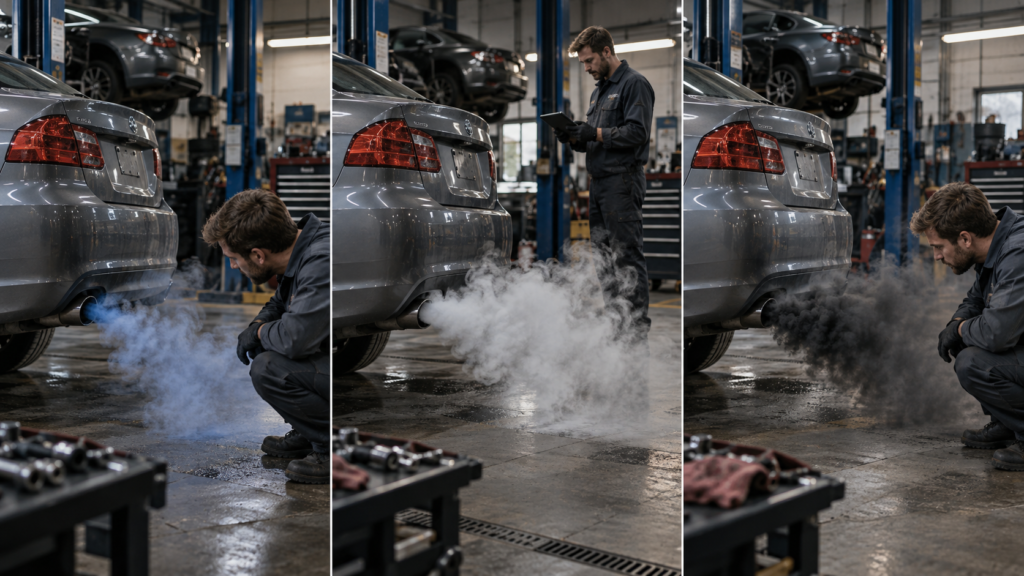
Blue Smoke From the Exhaust: Burning Oil
Blue or blue-gray smoke almost always means engine oil is being burned somewhere it shouldn’t be. It’s usually easiest to spot right after starting the car or when you first accelerate hard after coasting, since that’s when a small pool of oil that’s collected somewhere gets pulled into the combustion process all at once.
What Causes an Engine to Burn Oil
A few components are responsible for keeping oil out of the combustion chambers, and blue smoke shows up when one of them wears out:
- Worn valve seals, which let oil seep down into the cylinders past the valve stems, especially noticeable on startup after the car has sat overnight
- Worn piston rings, which let oil past the pistons from the crankcase, often worse under acceleration or when the engine is under load climbing an on-ramp
- A failing turbocharger seal on turbocharged models, which lets oil from the turbo’s bearing housing leak into the intake or exhaust side
- An overfilled crankcase, which can push oil past seals simply because there’s too much of it in there
A car that’s burning oil will also typically need top-ups between oil changes, so if you’ve noticed your dipstick reading low a few thousand kilometres before your next scheduled service, that’s a supporting clue alongside the smoke itself. Left unaddressed, oil consumption problems tend to get worse gradually rather than suddenly, but they can also foul spark plugs and damage the catalytic converter over time, turning a moderate repair into a more expensive one.
Black Smoke From the Exhaust: Too Much Fuel
Black or dark gray smoke means your engine is running rich, burning more fuel than it can properly combust. Unburned fuel and soot exit through the tailpipe as black smoke, and you’ll often notice reduced fuel economy and a rougher idle alongside it.
Common Causes of Black Smoke
- A clogged or dirty air filter, which starves the engine of the air it needs to balance the fuel mixture properly
- A failing oxygen sensor or mass airflow sensor, which feeds the engine computer bad data about how much fuel to add
- A stuck-open fuel injector, which dumps too much fuel into one or more cylinders
- A malfunctioning engine control module reading or a stuck fuel pressure regulator
Black smoke is usually the least expensive of the smoke colors to trace and fix, since a clogged air filter or a single sensor is a common culprit and a straightforward repair. That said, it’s worth having it looked at reasonably soon; running rich for an extended period wastes fuel with every tank and can eventually damage the catalytic converter, turning a simple sensor replacement into a much larger repair bill.
Gray Smoke: When It Could Be Either
Gray smoke sits in between blue and black and can be trickier to diagnose by eye alone. In many cases it’s actually blue smoke that looks gray in daylight, meaning it’s still an oil-burning issue. In automatic transmission vehicles, gray smoke with a distinct burning smell can also point to transmission fluid leaking onto a hot exhaust component, which is a different repair entirely and one that’s worth having a technician trace with a proper inspection rather than guessing from color alone. If you’re seeing thick gray smoke, especially combined with a burning smell that doesn’t match typical exhaust odor, that’s a good reason to book a diagnostic rather than wait it out.
Exhaust Smoke vs. Normal Cold-Weather Condensation in the GTA
Because Mississauga sees genuinely cold winters, this is worth calling out on its own. Every vehicle, gas or hybrid, will puff visible white vapour for the first minute or so after starting on a cold morning, and it’s often more noticeable on humid days or right after a snowfall. The way to tell normal condensation apart from a real problem is simple: normal vapour clears up within a couple of minutes and doesn’t return once the engine and exhaust system are warm. If you’re still seeing smoke twenty minutes into your drive on the highway, or it shows up consistently every single day regardless of temperature, that’s no longer just condensation.
When Exhaust Smoke Means You Should Stop Driving
Most smoke situations are safe to drive a short distance to a shop, but a few combinations call for pulling over rather than continuing your commute:
- Thick white smoke paired with a rising temperature gauge, which points to active overheating on top of a coolant leak
- Any smoke accompanied by a burning smell from inside the cabin, which can indicate an electrical or fluid leak issue elsewhere
- Smoke that suddenly gets much heavier over a few minutes of driving rather than staying steady
- Smoke combined with a loss of power or the engine running noticeably rough
In any of these cases, it’s safer to pull over safely, let the engine cool, and arrange a tow than to keep driving and risk turning a repairable problem into a replaced engine.
Diagnosing the Cause and What Repairs Typically Cost in Ontario
Because the same smoke color can point to more than one root cause, the fastest and cheapest path is always a proper diagnostic rather than replacing parts by guesswork. A technician will typically start with a visual inspection, a compression or leak-down test for oil-burning symptoms, a coolant system pressure test for white smoke, and a scan of stored engine codes for black smoke complaints.
Rough ranges for the GTA, before diagnostic time, generally run: a valve cover gasket or valve seal repair from a few hundred dollars up to around a thousand depending on the engine; a head gasket replacement from roughly fifteen hundred to twenty-five hundred dollars depending on the vehicle; an oxygen sensor or mass airflow sensor replacement typically two hundred to five hundred dollars; and an air filter or basic sensor cleaning under a hundred dollars. These are general ranges, and the only way to know your actual number is a proper inspection, since two cars showing the identical smoke color can have completely different root causes and price tags.
Quick Checks You Can Do Before Calling a Shop
Before you book an appointment, a few quick observations from your own driveway can help a technician get to the answer faster, and they cost nothing but a few minutes.
- Check the smell. A sweet, syrupy smell points to coolant. A sharp, burnt smell closer to a barbecue points to oil. A smell closer to rotten eggs usually points to a struggling catalytic converter rather than the smoke itself.
- Check the color in daylight rather than at night. Blue and gray smoke are easy to mistake for each other under streetlights or in a dim garage, and daylight makes the difference much clearer.
- Pop the hood and check your coolant reservoir and oil dipstick levels. A coolant level that’s dropped noticeably since your last check, or oil that reads low on the dipstick, supports what the smoke color is already telling you.
- Note when the smoke appears. Only at startup and gone within a minute points toward normal condensation or a minor issue. Smoke that continues the entire drive, or that gets heavier under acceleration, points toward something that needs attention soon.
- Check your dashboard for a check engine light or temperature warning. A light that appeared around the same time the smoke started is a strong clue about which system is involved.
None of this replaces a proper inspection, but it gives a technician a head start and helps you describe the problem clearly when you call to book.
Services at YST Tuning
If you’ve noticed smoke from your exhaust, these are the services most likely to come into play once we’ve diagnosed the cause:
Engine Service — for oil-burning, head gasket, and internal engine repairs
Exhaust & Mufflers — for exhaust system inspection and repair
Oil Change — to check oil condition and consumption between visits
Vehicle Maintenance — for a full inspection if you’re not sure where to start
Frequently Asked Questions
Is it safe to keep driving if there is smoke from your exhaust?
It depends on the color and what else is happening. Thin white vapour on a cold start is fine. Thick white smoke with a rising temperature gauge, or any smoke combined with a burning smell or a loss of power, means you should stop driving and have the car towed or inspected before continuing.
Why does my car smoke from exhaust more in the cold Mississauga winters?
Cold air makes normal water vapour condense faster and appear more visible right after startup, which is why smoke is more noticeable on winter mornings. As long as it clears within a couple of minutes and doesn’t return once the engine is warm, it’s a normal seasonal effect rather than a mechanical problem.
How much does it cost to fix an engine that’s burning oil or coolant in Ontario?
Costs vary widely by cause: a valve cover gasket might run a few hundred dollars, while a head gasket replacement is typically in the fifteen hundred to twenty-five hundred dollar range depending on the vehicle. A proper diagnostic is the only way to know which repair you actually need before committing to a number.
Can bad gas or a fuel problem cause smoke from the exhaust?
Yes. Fuel that’s contaminated with water or debris, or an engine that’s running rich because of a fuel system issue, can produce black smoke and a rough idle. This is usually one of the less expensive smoke causes to trace and repair compared to coolant or oil-related smoke.
Book an Exhaust Smoke Diagnostic in Mississauga
If you’ve noticed smoke from your exhaust that doesn’t match a normal cold start, don’t wait for it to get worse. The team at YST Tuning in Mississauga can trace the exact cause, whether it’s a simple sensor or a coolant leak into the engine, and give you a clear, honest repair estimate before any work begins. Contact us or book a diagnostic appointment today and get an answer instead of a guess.